

Cosmetic Ingredients That Can Worsen Hyperpigmentation
Why Some Skincare Products Darken Pigmentation Instead of Fading It
Hyperpigmentation is mainly driven by three things: inflammation, irritation, and UV exposure.
Anything that repeatedly upsets the skin barrier, causes stinging or redness, or makes skin more sensitive to the sun can trigger melanocytes (pigment cells) to produce more melanin. The result? Darker, longer-lasting patches.
This means that even products sold as brightening or anti-ageing can backfire if the ingredients are too harsh, unstable, overused, or poorly combined.
Warning signs that a product may be worsening your pigmentation include:
• Stinging or burning
• Redness
• New dark marks after breakouts or irritation
These are classic signs of post-inflammatory hyperpigmentation — Irritation from cosmetics ingredients can create more pigment instead of fading it.
Check out our hyperpigmentation skincare analyzer
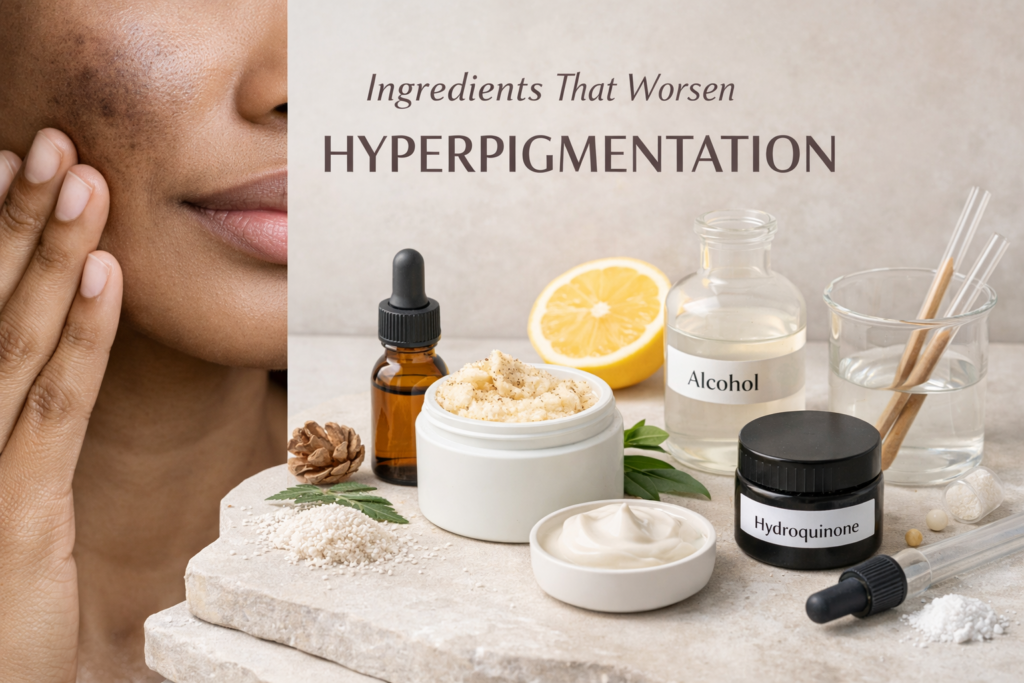
Common Skincare Ingredients That Can Make Hyperpigmentation Worse
1. Exfoliating acids and harsh scrubs
AHAs and BHAs (such as glycolic, lactic and salicylic acid) can help fade pigment when used properly. But they are a double-edged sword.
When used too often, at high strengths, or layered with other strong actives, they can damage the skin barrier and increase sun sensitivity — two major triggers for pigmentation.
Common problems:
• Strong at-home peels or daily high-strength glycolic acid can cause redness, burning and rebound darkening
• Physical scrubs and stiff cleansing brushes create micro-injury that can heal as dark marks
• Chemical peels can potentially help, but on sensitive or melanin-rich skin, which is frequently the case, they can trigger pigmentation if too strong or followed by poor sun protection
Safer approach:
Lower-strength acids, used less frequently, or gentle enzyme exfoliants — especially for sensitive and darker skin tones. Of course, never forget your sunscreen.
2. Fragrance, essential oils and artificial dyes
Fragrance is one of the most common causes of low-grade skin irritation. On deeper skin tones, this irritation often shows up as uneven pigmentation rather than visible redness.
It may appear on labels as fragrance, parfum or aroma. But also has many names like 2,6-Dimethoxyphenol, Hydroxy acetone and many more, I mean hundreds or maybe even thousands of chemicals. If a cosmetic product smells too strong, I would be very hesitant to use it on my face.
Higher-risk ingredients include:
• Synthetic fragrance
• Citrus oils (bergamot, lemon, lime, bitter orange)
• Some floral oils (lavender, ylang-ylang)
• Synthetic colour dyes
These can irritate skin or increase sun sensitivity, quietly worsening pigmentation over time.
For hyperpigmentation-prone skin, fragrance-free or very low-fragrance formulas are usually safer.
3. Drying alcohols and barrier-stripping toners
Toners and mists that contain large amounts of drying alcohol (ethanol, SD alcohol, isopropyl alcohol) can feel refreshing at first — but they strip protective lipids from the skin.
Chronic dehydration weakens the barrier, leading to:
• Increased sensitivity
• More inflammation
• Reactive oiliness
• Higher risk of pigmentation
Not all alcohols are bad. Fatty alcohols (cetyl, stearyl) are different and usually help with texture and stability.
The problem is when denatured alcohol appears high on the ingredient list.
4. Problematic “skin-lightening” ingredients
Some well-known pigment-fading ingredients can actually cause stubborn or permanent darkening when misused, especially on darker skin tones.
Hydroquinone
Hydroquinone is a powerful pigment inhibitor, but:
• Long-term or unsupervised use can cause bluish-black staining (exogenous ochronosis)
• It increases sun sensitivity
• It can cause rebound pigmentation when stopped
• Many countries restrict it in cosmetics including New Zealand
It should only be used short-term and under medical supervision with strict sun protection.
Arbutin
Marketed as a gentler option, but it can:
• Cause irritation and sensitivity
• Increase sun vulnerability
• Trigger rebound pigmentation with long-term or high-dose use
Kojic acid
Often found in brightening soaps and serums:
• Commonly causes redness and burning
• Increases photosensitivity
• Can worsen post-inflammatory hyperpigmentation
For melanin-rich skin, these ingredients are best avoided or used with professional guidance only.
5. Overuse of retinoids and active layering
Retinoids (retinol, retinal, tretinoin) can improve acne and pigmentation — but they often cause dryness and redness at first.
If the skin stays inflamed, pigmentation can temporarily worsen or new dark marks can appear.
Risk increases when:
• Retinoids are combined with strong acids, benzoyl peroxide or high-strength vitamin C
• Strength or frequency is increased too quickly
• The barrier is not supported
Gentler approach:
Low strength, slow introduction, barrier-supportive moisturisers, and daily sunscreen.
6. Heavy, pore-clogging products in acne-prone skin
If your pigmentation comes from acne, anything that increases breakouts will increase dark marks.
Some heavy occlusives and thick silicone-rich skin creams and ointments can trap sweat and oil, leading to black heads especially in warm, humid climates.
More breakouts = more inflammation = more pigmentation.
Best choice:
Breathable, non-comedogenic textures and proper makeup removal.
7. Unregulated bleaching creams and steroid products
Some cheap “whitening” creams bought online or from informal markets may contain:
• Corticosteroids
• High-dose hydroquinone
• Unlisted active drugs
Long-term use can cause:
• Thinning skin and visible veins
• Severe rebound pigmentation
• Acne and dermatitis
• Patchy, uneven tone
Any unlabelled or suspicious product should be treated as a medical unregulated drug, not skincare.
| Ingredient / Group | Possible Risk | Effect on Pigmentation |
|---|---|---|
| High-strength AHAs (glycolic, lactic) | Over-exfoliation and damages barrier | Triggers inflammation and rebound darkening |
| Physical scrubs & brushes | Micro-injury to skin | Heals as darker marks |
| Fragrance / Parfum / Aroma | Ongoing irritation | Leads to uneven tone over time |
| Citrus essential oils (bergamot, lemon, lime) | Phototoxic and sensitising | Increases UV-induced pigment |
| Steroid-based bleaching creams | Thins skin, masks inflammation | Severe rebound hyperpigmentation |
| Hydroquinone | Ochronosis and rebound pigmentation | Can cause permanent darkening and/or eczema |
| High-dose arbutin | Can irritate and photosensitise | Rebound pigmentation possible |
| Kojic acid | Frequently irritating | Worsens PIH in darker skin |
| Strong retinoids (overused) | Causes peeling and redness | New dark spots may appear |
| Heavy occlusives in acne-prone skin | Traps oil and sweat | More breakouts → more inflammation → more pigment |
Safer skincare guidelines for hyperpigmentation
Hyperpigmentation-prone skin does best with low irritation, strong barrier support and consistent sun protection.
Favour:
• Gentle cleansers
• Barrier-supportive moisturisers
• Fragrance-free formulas
• Well-tolerated brighteners
Use cautiously:
• AHAs and BHAs
• Retinoids
• Benzoyl peroxide
• Strong vitamin C
(especially when combined with other products or used daily)
Avoid or use only with guidance:
• Hydroquinone
• Unregulated bleaching creams
• Long-term high dose arbutin or kojic acid
• Strong unbuffered acids
• Irritating fragrance and phototoxic essential oils
Simple rule:
If a product keeps stinging, making your skin red or flaky, it’s time to stop using them and moisturize and heal the skin. Sunscreen is always a must.
How This Relates to Our Formulation Philosophy
At Beauty Fields, our approach to hyperpigmentation is based on the idea that calm skin fades pigment better than irritated skin. Instead of using aggressive bleaching agents or harsh exfoliation, our products are designed to support the skin barrier while gently discouraging excess pigment production. We focus on low-irritation formulations, avoid fragrance and phototoxic essential oils, and prioritise ingredients that work with the skin rather than forcing it into shock. Our goal is steady, healthy fading that does not create rebound pigmentation or long-term damage. This is why our hyperpigmentation treatment cream and Soap are made to suit dark skin types too.
FAQ – Hyperpigmentation & Problematic Skincare Ingredients
Yes. Any product that repeatedly irritates the skin, weakens the barrier, or increases sun sensitivity can trigger more melanin production. This leads to darker and longer-lasting marks instead of fading.
Inflammation activates melanocytes (pigment cells). When skin heals after irritation, it often heals darker, this process is called post-inflammatory hyperpigmentation (PIH).
Not inherently. AHAs and BHAs can help when used correctly. Still, overuse, high strengths, inadequate sun protection, or combining too many actives can damage the barrier and worsen pigmentation, especially in melanin-rich skin.
Yes. Fragrance is a major cause of low-grade irritation. On darker skin tones, this irritation often shows up as pigmentation rather than redness.
Ingredients like hydroquinone, arbutin, and kojic acid suppress melanin aggressively. If they irritate the skin or increase sun sensitivity, they can cause rebound pigmentation or permanent darkening when misused.
Yes. Every breakout causes inflammation, which leads to pigment. Products that clog pores or worsen acne indirectly worsen pigmentation, too.
Red flags include:
• Burning or stinging
• Ongoing redness
• Peeling that never settles
• New dark marks after irritation
If this happens, the product may be part of the problem.

Tsahallah is a pharmacist (B.Pharm, University of Jerusalem) and the founder of Beauty Fields NZ, specialising in hyperpigmentation, melasma, and post-inflammatory pigmentation. Her work focuses on safe, long-term, natural skincare solutions supported by education and scientific research.