

Melasma vs Hyperpigmentation: What’s the Difference?
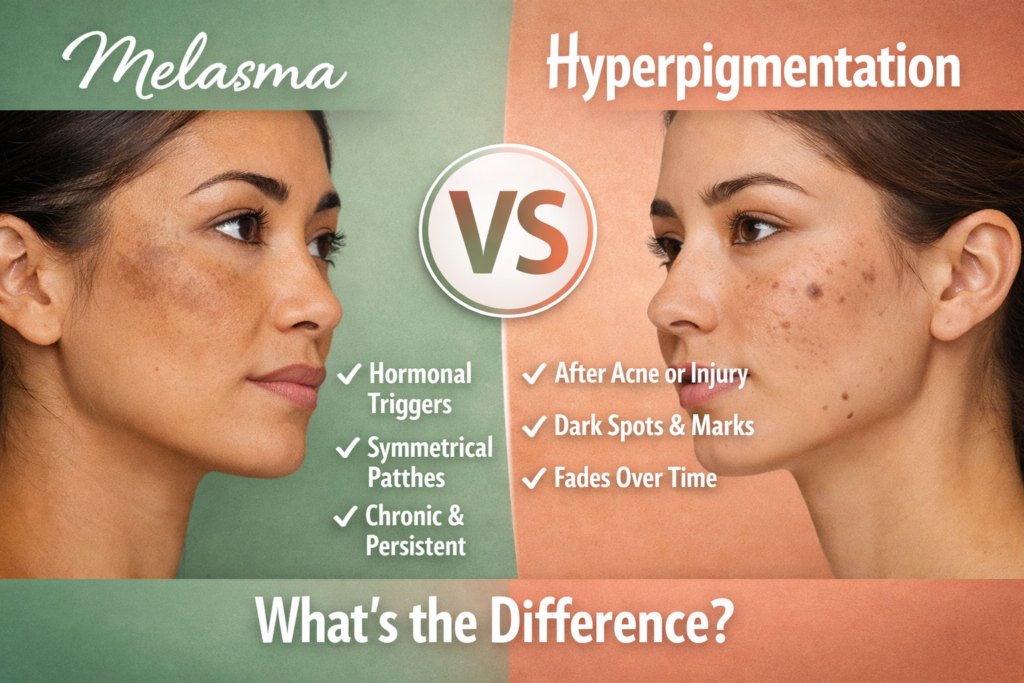
Melasma and hyperpigmentation are often confused, but they are not the same condition. Melasma is a specific kind of hyperpigmentation. While both cause dark patches or uneven skin tone, they have different causes, patterns, and treatment responses. Understanding the difference is essential for choosing the right skincare and avoiding products that may worsen pigmentation.
In this guide, we explain:
- What melasma is
- What hyperpigmentation is
- How they differ
- How each should be treated
What Is Hyperpigmentation?
Hyperpigmentation is a general term for any darkening of the skin caused by increased melanin production. It usually occurs after inflammation, injury, or sun exposure.
Common types include:
- Post-inflammatory hyperpigmentation (PIH) – dark marks after acne, eczema, burns, or irritation
- Sun spots (solar lentigines) – from long-term UV exposure
- Freckles – genetically influenced
- Product- or drug-induced pigmentation
Hyperpigmentation is often:
- Localised (single spots or patches)
- Triggered by skin trauma
- Considered easier to treat but this depends on many factors.
- Gradually fades over time with proper sun protection – A spot from a mosquito bite on your belly will disappear faster than an acne scar, because it’s less exposed to the sun. Sun and Hyperpigmentation are closely related.
What Is Melasma?
Melasma is a chronic pigment disorder that causes symmetrical brown or grey-brown patches, most commonly on the face. It is strongly linked to hormonal changes and UV exposure.
Melasma usually appears on:
- Cheeks
- Forehead
- Upper lip
- Chin
- Pregnancy
- Oral contraceptives
- Hormone replacement therapy
- Sun exposure
- Heat
- Certain irritating skincare products
Melasma is typically:
- Bilateral (both sides of the face)
- Long-lasting or recurrent
- Considered more difficult to manage, depends on the case.
- Highly sensitive to UV and heat
Key Differences Between Melasma and Hyperpigmentation
| Feature | Melasma | Hyperpigmentation (PIH) |
|---|---|---|
| Main cause | Hormones + UV | Inflammation or injury |
| Pattern | Symmetrical patches | Localised spots |
| Location | Mainly face | Anywhere on body |
| Behaviour | Chronic, recurring | Often fades with time and SPF |
| Treatment response | It’s complicated | Usually predictable |
| Triggered by acne | Rare | Very common |
| Heat sensitivity | High | Variable |
Why Treatment Must Be Different
Treating melasma like acne marks can make it worse.
Melasma:
- Reacts poorly to irritation
- Can worsen with strong exfoliation
- Darkens rapidly with sun exposure
- Relapses easily
Hyperpigmentation (PIH):
- Responds better to exfoliation
- Improves with pigment inhibitors
- Fades as skin renews
- Tolerates stronger treatments (with care)
Using the wrong approach can lead to:
❌ melasma! 😩
❌ rebound pigmentation
❌ darker patches
❌ longer recovery time
Best Treatments for Melasma
Melasma treatment should focus on:
✔ pigment suppression
✔ inflammation control
✔ UV protection
Helpful ingredients include:
- Beauty Fields Natural Skin Lightening – We really do think we are the best but you are welcome to explore the other options before getting back to us!
- Tranexamic acid
- Azelaic acid
- Niacinamide
- Alpha arbutin
- Vitamin C
- Licorice extract
Key principles:
- Gentle cleansing
- Avoid fragrance, in general I would go for baby skincare products.
- Daily SPF 50+ sunscreen, re-apply as needed.
- Avoid excessive heat exposure
- Consistent long-term routine
Procedures such as lasers and deep chemical peels may:
⚠ provide short-term improvement
⚠ but often cause relapse
⚠ and sometimes worsen pigmentation
There is always the option of Hydroquinone in NZ it’ll most likely the first thing that your doctor will give you. I’m not a fan! Like many others I used it myself and things got worse after the got better.
Best Treatments for Hyperpigmentation (PIH)
Post-inflammatory hyperpigmentation can respond well to:
- Beauty Fields all natural soap and cream for hyperpigmentation.
- Vitamin C
- Retinoids (used carefully, preferably only of you’re white)
- Chemical exfoliants (Even more carefully, not great for darker skin color)
- Azelaic acid
- Kojic acid
- Alpha arbutin
Important steps:
- Treat the underlying inflammation (acne, eczema)
- Protect from UV exposure
- Avoid picking or scrubbing
- Support the skin barrier
PIH typically fades gradually when treated appropriately.
How to Tell Which One You Have
You may have melasma if:
- Pigmentation is symmetrical
- It developed during pregnancy or hormone use
- It darkens quickly in the sun
- It appears mainly on cheeks
- You are a women.
You may have hyperpigmentation if:
- It followed acne or skin injury
- It appears as individual spots
- It improves slowly with sun protection and calming skincare
- It’s not on the face
- You are a men.
Many people experience both conditions at the same time, especially after treating with exfoliants and harsh chemicals.
Why Some Products Worsen Pigmentation
Certain ingredients can increase inflammation or photosensitivity, which can worsen both melasma and hyperpigmentation:
- Fragrance
- Some essential oils
- Benzoyl peroxide (You treat your acne and you get pigmentation, up to 33%)
- High-strength retinoids
- Harsh exfoliants
Pigmentation-prone skin benefits from:
✔ low-irritation skincare
✔ skin barrier support
✔ sun protection
✔ gentle consistent routines are better than harsh chemicals
These principal are important if you want to avoid Post-Inflammatory Hyperpigmentation on top of what you already have.
Melasma vs Hyperpigmentation: Summary
Melasma and hyperpigmentation may look similar, but they behave very differently.
Melasma is:
- Hormone-driven
- Chronic
- More sensitive to irritation
- Considered harder to fade
Hyperpigmentation is:
- Inflammation-driven
- More temporary
- Considered easier to treat
- More predictable
Correct identification leads to:
✔ safer treatment
✔ fewer relapses
✔ better long-term results
Final Thoughts
If your dark patches return quickly despite treatment, melasma may be the cause rather than simple hyperpigmentation. Melasma requires a gentle, long-term approach focused on sun protection and pigment control, rather than aggressive exfoliation.
Understanding which type of pigmentation you have helps prevent worsening and improves treatment success.
Beauty Fields pigmentation products are a gentle and safe way to treat both, try us first!
❓ FAQ
No. Melasma is a specific chronic pigmentation disorder linked to hormones and sun exposure. Hyperpigmentation is a general term for darkening of the skin caused by inflammation, injury, or UV damage. Melasma is one kind of hyperpigmentation, but hyperpigmentation is not always melasma.
Melasma is usually harder to treat because it is chronic and easily triggered by sun and irritation. It’s always on the face so more exposed to sun damage. Hyperpigmentation caused by acne or injury often fades more predictably, especially if not on the face. We have seen great results with Beauty Fields products and sun protection.
No. They are different conditions, but a person can have both at the same time. BUT harsh treatments can eventually lead to adding melasma to the hyperpigmentation you wanted to get rid of or the other way around.
Melasma may fade, but it often returns with sun exposure or hormonal changes. Long-term management is usually required. Melasma that occurred during pregnancy and not synthetic hormones will usually fade faster.
Yes. Harsh exfoliation, fragrance, strong retinoids and more can worsen melasma by increasing skin inflammation and making the skin even more sensitive to sun damage.
📚 Scientific References
- Grimes PE. Melasma: etiologic and therapeutic considerations. Arch Dermatol. (1995)
- Handel AC et al. Melasma: a clinical and epidemiological review. An Bras Dermatol. (2014)
- Davis EC & Callender VD. Postinflammatory hyperpigmentation: a review of the epidemiology, clinical features, and treatment options. J Clin Aesthet Dermatol. (2010)
- Kang HY et al. Melasma: histopathological characteristics. J Am Acad Dermatol. (2002)
- Taylor SC et al. Postinflammatory hyperpigmentation. J Cutan Med Surg. (2009)

Tsahallah is a pharmacist (B.Pharm, University of Jerusalem) and the founder of Beauty Fields NZ, specialising in hyperpigmentation, melasma, and post-inflammatory pigmentation. Her work focuses on safe, long-term, natural skincare solutions supported by education and scientific research.